Local weather advisory
The National Weather Service has issued a coastal flood advisory covering Berkeley. Heavy rain and drainage loading can expose roof leaks, blocked drains, and ponding water. This is a weather exposure advisory; it does not establish damage to a specific roof.
Do not access a roof during hazardous weather. Protect people first, avoid water near electrical equipment, and request roofing help when conditions permit.
National Weather Service · Updated Oct 28, 2026, 7:20 AM UTC
Commercial roofing in Piedmont from our Berkeley crew: blisters in built-up and asphalt roofs checked, cut and repaired only when they actually need it.
Service Areas | Berkeley, CA
Blisters are common on built-up and asphalt roofs. A blister forms when air or moisture gets trapped between layers and the heat of the sun puffs it up. Some sit there harmlessly for years. Others crack open and let water straight into the roof. We inspect and repair commercial roofs in Piedmont from our base in Berkeley, CA, and we check each blister before deciding whether to leave it alone, watch it, or cut it out and repair it.
Piedmont is mostly residential, but it has civic and commercial buildings, like Community Hall on Highland Avenue and the city offices on Vista Avenue, plus businesses along its edges with Oakland. Every roof gets its own look. Our built-up roofing work is based on what we find on that roof, since an asphalt roof can have several plies and layers under its surface.
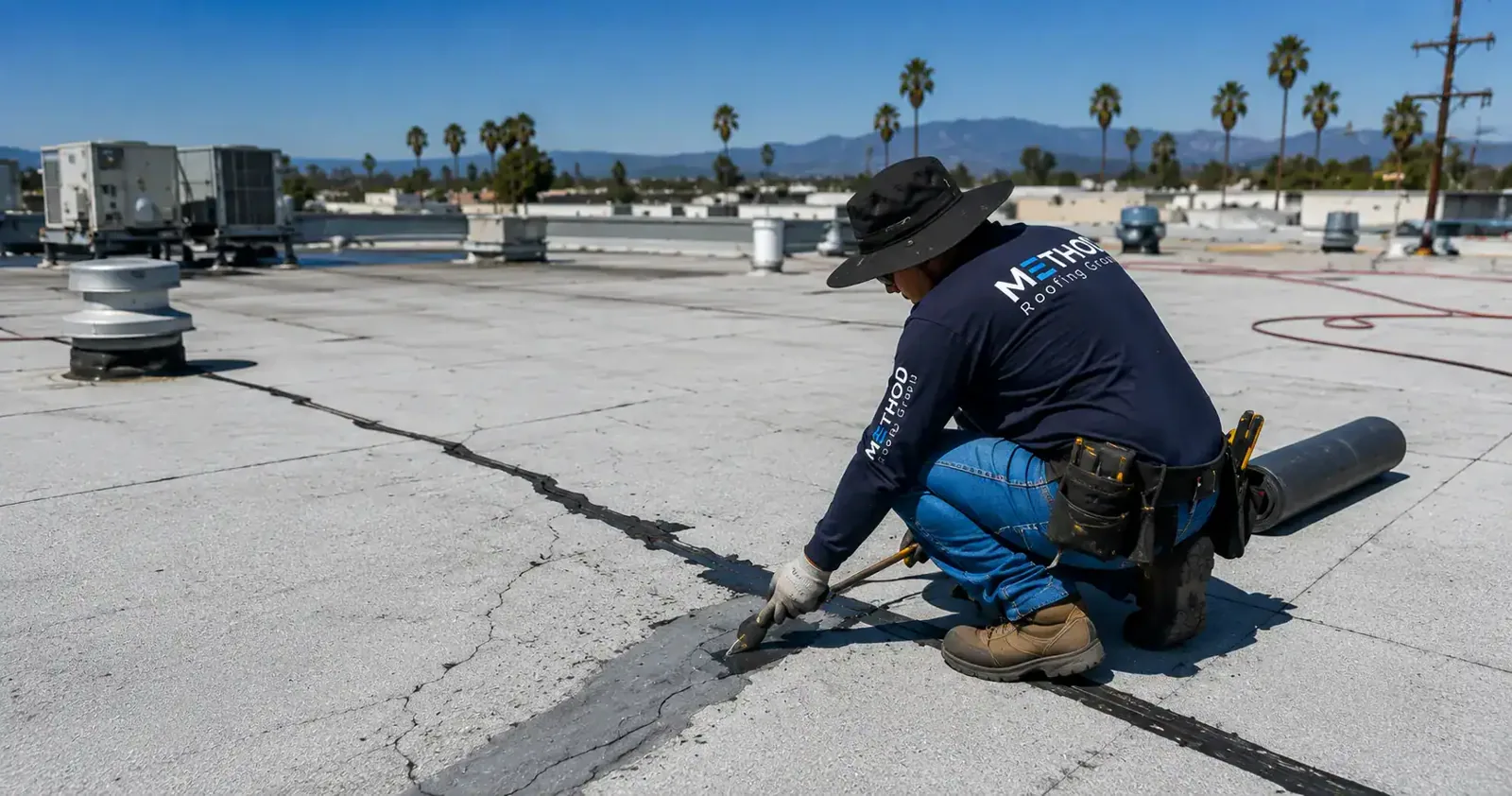
A blister can be in the top coating or deeper between the plies of the roof. We look at the edges of the blister and the roof around it. If it has cracked or opened at an edge, that changes things a lot. Before we cut one open, we explain what we are trying to find out, and we photograph and record what we see inside.
Our roof inspection separates a bump on the surface from an actual leak. A photo of a blister does not show what is underneath. We compare it with the roof around it and decide if opening it is worth it. You see what we found and what we could not confirm, so you can decide on the next step without cutting into the roof for no reason.
An unbroken blister and a cracked one are different problems. A cracked blister lets water in, and the insulation under it may be wet or soft. We check for openings, look at the roof around it, and decide how far the repair has to go. If we recommend cutting it out, we explain why that spot needs it.
Our commercial roof repair on blisters depends on the roof type and its condition. Cutting out a blister and the loose plies around it often leaves an area bigger than the bump itself, because the patch needs room to bond to solid roof. We show you the layout and the photos. That lets you compare a real repair with a quick surface patch.
When a blister has split, water may have gotten into the plies or insulation under it. We check before deciding what can stay. With your approval, small cores can confirm whether the insulation is wet. One wet core does not tell us how far the moisture goes, so we may check a little farther out. The repair has to tie into dry, solid roof.
Our roof insulation and cover board replacement removes the wet layers and keeps dry, solid material in place. If the deck underneath looks damaged, we recommend getting it evaluated before we cover it. You see where the repair ends and anything still unresolved. That way a surface patch never hides a bigger problem underneath.
A coating only works if the roof under it is solid. Open blisters and loose plies have to be repaired first. The coating also has to be compatible with the asphalt roof and properly prepped. If many areas are separating, a coating may not be the right choice at all, and we tell you that alongside the coating price.
Our roof coating restoration estimates include the blister repairs and prep work. Adhesion tests at a few spots tell us whether the coating will bond there, but they do not prove the whole roof is sound underneath. If the problems are widespread, more testing or a different approach may be better. You can compare what each option actually fixes.
Cutting out a blister opens the roof over a room. We find out what is below and agree with the manager on how to protect it. Debris and materials need a clear route through the building, and nearby equipment can limit where we can work. We only open as much as we can seal again the same day.
A building on Highland Avenue may have a different route to the roof than one near Vista Avenue. If you also have properties in Rockridge or North Oakland Temescal, we can schedule the inspections together. Each building still gets its own repair plan based on its own rooms, access and roof condition.
Completion photos show where the repair is relative to fixed landmarks on the roof, along with the layers we removed before the patch covered them. At a later visit, anyone can compare the repaired area with any new blisters. A blister somewhere else is checked on its own, not assumed to be the same problem.
A bigger project needs a bigger pattern of problems. Blisters splitting across large areas may justify a closer look at the whole roof. One blister usually just needs a local repair. We explain which you have, and you can plan confirmed repairs and any further testing separately.
Piedmont is a small, mostly residential city surrounded by Oakland, so we confirm the exact address and owner before sending a crew, especially for buildings near the city line. Public buildings and schools may need work scheduled around programs and secure access. We check the roof surface, edges and drains separately, and note any trees that drop leaves into the drains. That keeps the job clearly tied to the building that asked for service.
Let us check the blisters before anyone adds another layer. You get plain photos and an honest answer on whether to leave them, watch them or repair them.
Request a Roof Assessment