Local weather advisory
The National Weather Service has issued a coastal flood advisory covering Berkeley. Heavy rain and drainage loading can expose roof leaks, blocked drains, and ponding water. This is a weather exposure advisory; it does not establish damage to a specific roof.
Do not access a roof during hazardous weather. Protect people first, avoid water near electrical equipment, and request roofing help when conditions permit.
National Weather Service · Updated Oct 28, 2026, 7:20 AM UTC
Berkeley roof work in West Berkeley begins with drain and flashing findings. We define dry repair limits and plan deliveries around occupied buildings.
Service Areas | Berkeley, CA
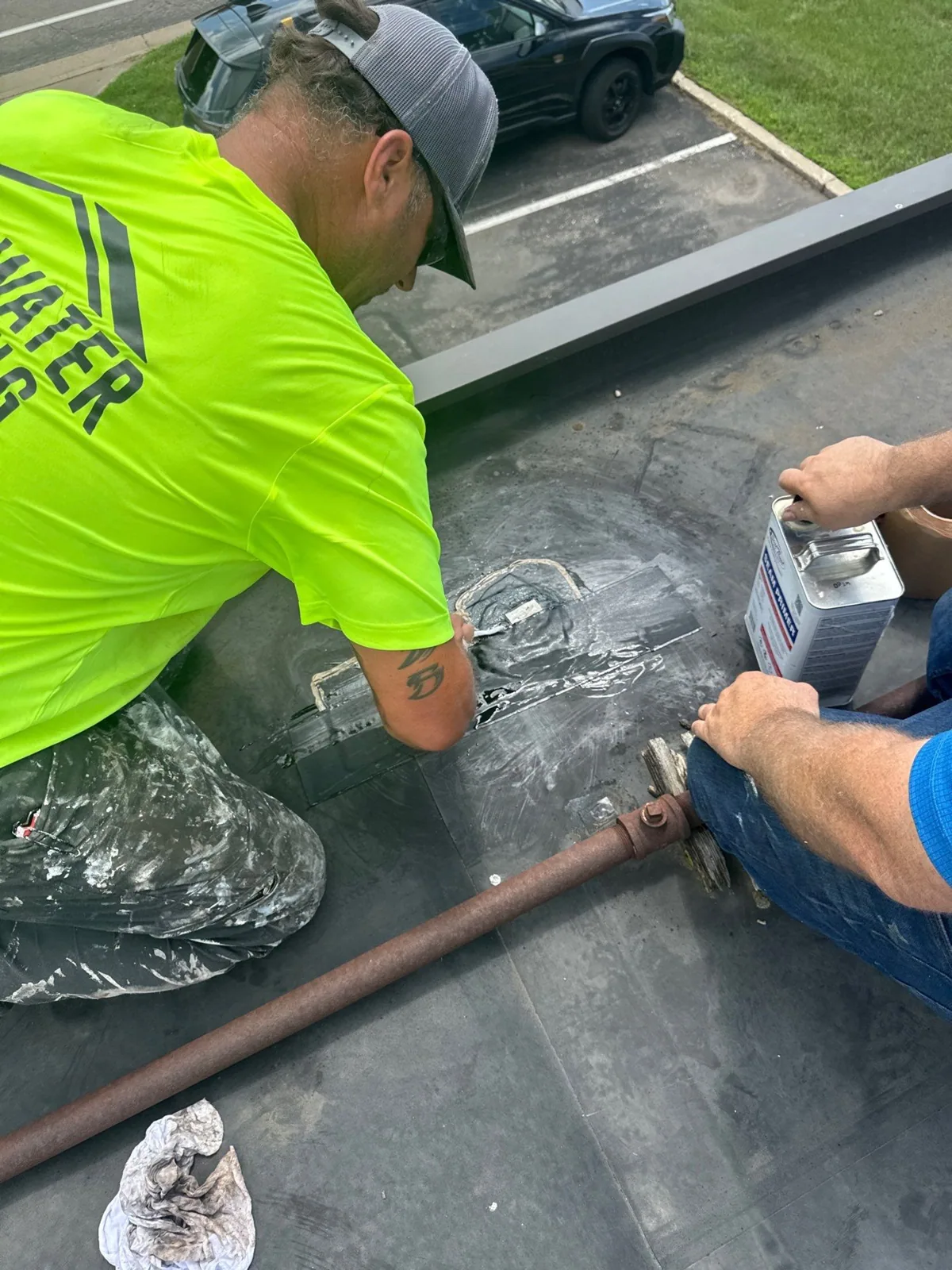
Beside a roof drain, dark insulation changes the repair conversation. We inspect and repair commercial roofs in West Berkeley, CA. A membrane split near the bowl may look easy to patch. The damp material underneath can make that patch incomplete. We examine the drain connection and the layers around it. An owner needs to know what can remain, not just what looks damaged.
Many West Berkeley roofs sit close to busy corridors like University Avenue and San Pablo, so a job here needs planning on the ground as well as on the roof. Where the crane or hoist sets up, which entrance stays open and how we reach the drains all go into the same scope. We confirm those conditions on the site visit rather than guessing at them. Our drain and scupper repairs address the outlet connection as well as the surrounding membrane.
A split beside the drain may start at a strained connection. The membrane can pull against a bowl with inadequate support. An existing clamp may also fail to hold its intended assembly. We inspect the drain body, connecting material and nearby roof slope. The visible split tells us where to look closely. It does not settle which component first allowed water inside.
A clear outlet can still leak at its roof connection. We check for cracks, loose parts and incompatible past repairs. A plumber may need to inspect concealed piping or a failed joint below. We define that trade boundary before closing the roof-side work. A leak repair at the outlet needs a sound receiving surface. Replacing the membrane around a damaged bowl could leave water entering underneath. The correction follows the parts that actually fail inspection.
A damp sample beside the drain calls for a wider investigation. Water can move through joints between insulation boards beneath the sheet. Its extent may exceed the stain visible inside the building. We compare direct observations with targeted testing of the surrounding area. Small exploratory openings help establish the boundary when access is approved. Each opening gets restored after its condition is recorded.
Removal follows wet or unstable material, not an arbitrary circle. We check the supporting deck where the roof layers are lifted. Corrosion, deterioration or movement can require separate evaluation before replacement layers go down. The insulation and cover board repair must suit the retained assembly. Transitions need firm support without creating another low area at the drain. We price the known removal and identify any concealed-condition approval clearly. That leaves the owner a decision grounded in the opened roof.
A sample taken at the drain should be labeled precisely. We record its position relative to the bowl and nearby features. Another opening farther away helps test the proposed removal boundary. The manager can then follow why those limits changed. That record also helps explain a later repair in the same area.
A raised patch can interfere with the last stretch toward an outlet. We examine the finished surface height before choosing new layers. Drain hardware and membrane detail need to work with that height. Removing wet boards without checking the drainage plane may repeat the problem. A repair that closes the leak can still hold water beside it. We consider both findings in the same detail.
Standing water also deserves an explanation beyond the outlet itself. Surface debris, deflection or poorly connected roof planes can contribute. We distinguish a serviceable drain from a broader slope problem. A limited repair may need tapered material within its defined area. A larger correction may require a separate design and replacement scope. Our repairs for persistent ponding begin with that distinction. The owner sees why a drain cleaning and a drainage correction differ.
Opening roof layers above a working room needs a controlled daily boundary. We check the room use and what water entry could affect. Materials and debris need routes away from the public entrance. The manager identifies occupied spaces that require added protection or coordination. We set the work area to match the available protection. A planned closure stays small enough to complete and secure.
On a building along University Avenue, we check where materials can be dropped before anything is ordered. That answer depends on the street frontage and loading space at that one property. A roof visit in downtown Berkeley may involve a different lifting route. The same applies to a separate property in Emeryville. We confirm access at each property rather than carrying one plan between them. The owner can then schedule occupied-room protection and deliveries together. Clear daily responsibilities help prevent a roof repair from disrupting unrelated work.
A repaired drain can expose wear at other outlet connections. We photograph those details without adding them silently to the current job. The record separates an active defect from a watch item. It also shows whether the adjacent material remains firm and dry. Those observations give the owner something concrete for the next budget. They do not require replacing sound areas merely for uniform appearance.
A written condition record identifies the outlet and the checked surroundings. We include the completed repair and any unresolved piping concern. Later maintenance can compare that location with the original photographs. Our roof records for ongoing ownership keep those decisions attached to the actual detail. A recurring split would prompt a review of movement or attachment. A stable repair would support keeping that portion in service. The follow-up decision rests on what the roof shows afterward.
West Berkeley retains a broad mix of maker, food-production, laboratory and warehouse buildings, often with tenant-specific roof equipment. Before we start, we ask whether production schedules, lab access rules or food-safety requirements limit where and when we can work. Older industrial conversions often carry additions and abandoned penetrations, so we check every roof-to-wall transition and flag openings that no longer serve any equipment. The neighborhood's history tells us what to look for, not what condition a particular roof is in. Findings are marked building by building, and protection is planned with the business working underneath.
Let us look at the drain connection and the material beneath it. You will receive plain photos and a clear account of what can stay.
Request a Roof Assessment